
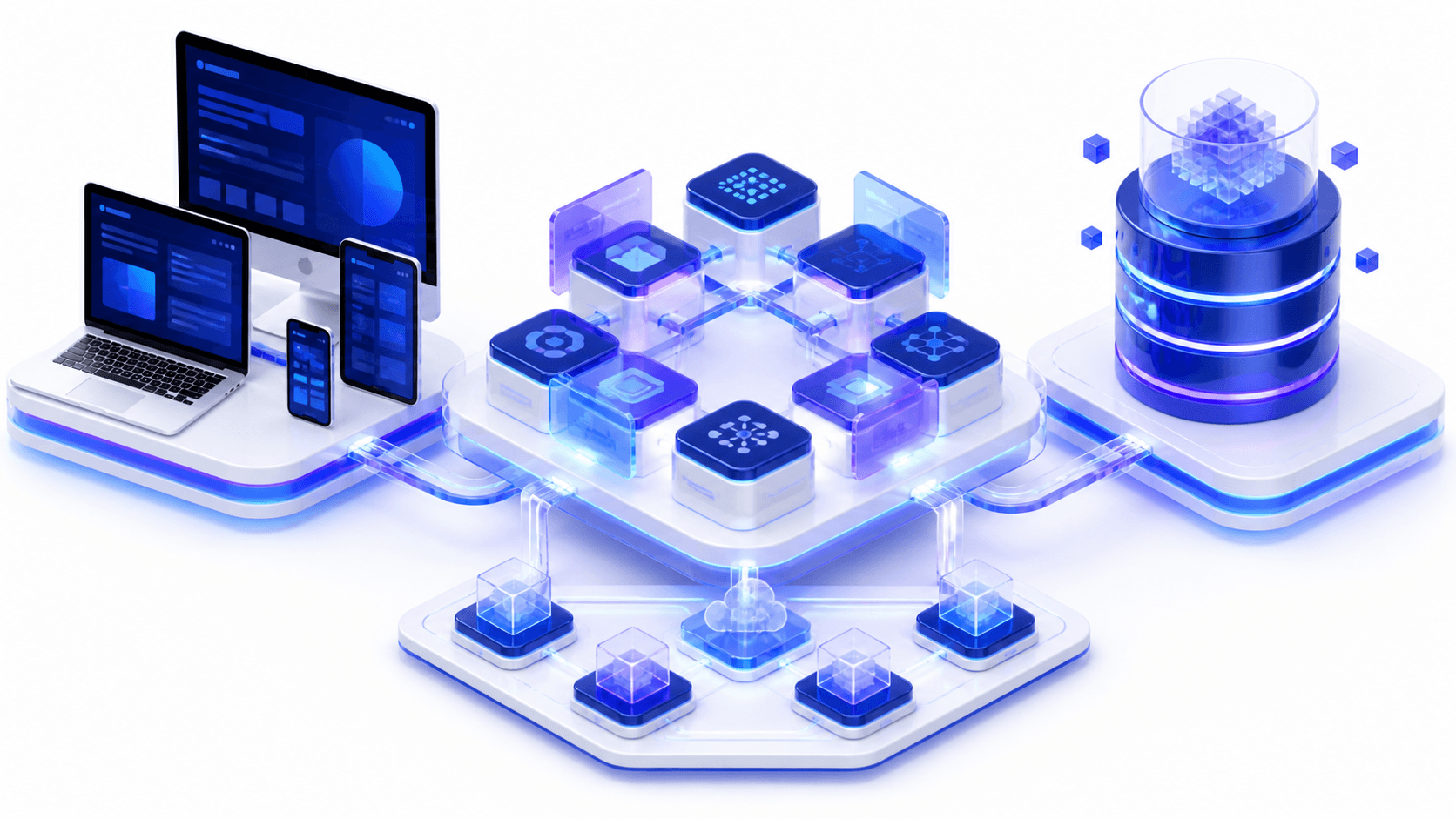
What’s Driving Change in Full-Stack Development?
The full-stack landscape is evolving faster than ever. Developers are embracing tools and paradigms that accelerate development, improve performance, and reduce operational overhead — all while meeting higher user expectations for speed, reliability, and personalization. As we look toward 2026, several key trends are converging to redefine how products are built and scaled.
1. AI-Augmented Development Workflows
AI isn’t just for end-user features — it’s reshaping how developers work. From intelligent code autocompletion and automated refactoring to generation of tests and documentation, AI tools are reducing repetitive tasks and surfacing best practices in real time. Teams that integrate AI into their workflows can ship features faster and maintain higher quality.
2. Edge Computing Everywhere
The “edge” — running code closer to users — continues to expand beyond CDN caching into full application logic. Edge Functions and edge-native databases reduce latency, enable localized personalization, and improve resilience. Full-stack frameworks are increasingly delivering hybrid deployment models where routing, caching, and computation occur at the edge by default.
3. WebAssembly (Wasm) in the Browser and Beyond
WebAssembly is moving from niche use cases to mainstream adoption. It enables high-performance modules compiled from languages like Rust, Go, and C++ to run securely in browsers and edge environments. Expect Wasm to power complex data visualizations, real-time processing, and CPU-intensive logic without sacrificing speed or interoperability with JavaScript.
4. Rust and Type-Safe Backends
Safety and performance are top priorities. Rust’s memory safety guarantees and blazing speed make it a compelling choice for backends, microservices, and systems tooling. Meanwhile, TypeScript’s dominance persists on the frontend and increasingly on the server via frameworks that unify type systems across client and server, reducing runtime bugs and improving DX.
5. Meta-Frameworks & Component-Driven Architectures
Frameworks that bundle routing, data fetching, rendering strategies, and build optimizations are in high demand. Meta-frameworks (e.g., those built on React, Svelte, or Vue ecosystems) simplify SSR, ISR, and progressive enhancement, enabling teams to focus on features instead of configuration. Component-driven design systems ensure UI consistency while facilitating reuse.
6. Serverless & Function-as-a-Service (FaaS)
Serverless computing continues to reduce operational burden. Teams adopt FaaS for APIs, background jobs, and event-driven logic, benefiting from auto-scaling, reduced cost at idle, and simplified deployments. Integration with edge platforms lets serverless functions respond even faster to global audiences.
7. Observability as a First-Class Citizen
Modern full-stack teams prioritize visibility into performance and reliability. Observability — encompassing logs, traces, metrics, and real-user monitoring — is essential for diagnosing complex interactions across frontend, backend, and network layers. Built-in dashboards, alerts, and distributed tracing help maintain user satisfaction as systems scale.
8. API-First and Composable Architectures
APIs remain the glue of modern applications. Adopting API-first design — where contracts are defined upfront with tools like OpenAPI and GraphQL — improves cross-team collaboration and enables composable architectures. Teams can integrate best-of-breed services and swap implementations with minimal disruption.
9. Real-Time & Collaboration Features
Expect more apps to embed real-time capabilities — live updates, presence, and shared editing — as expectations grow for interactive experiences. WebSockets, WebRTC, and server-push patterns combined with conflict-free replicated data types (CRDTs) help build responsive collaboration tools.
10. Security Shift-Left & Privacy Engineering
Security is moving earlier into the development process. Dependency scanning, static analysis, and continuous security testing integrate into CI/CD pipelines. Teams also adopt privacy engineering practices to meet rising regulatory and user expectations around data minimization, consent, and transparency.
What This Means for Teams in 2026
- Faster Feedback Cycles: Integrated testing, type-safe systems, and AI assistance help teams catch issues earlier and ship confidently.
- Global Performance by Design: Edge-native deployments and observability ensure consistent performance worldwide.
- Resilience & Reliability: Composable services and serverless platforms reduce single points of failure while enabling rapid iteration.
- Developer Experience (DX): Unified tools, clear APIs, and automation lead to higher productivity and lower cognitive load.
How to Prepare Your Stack for 2026
- Assess Your UI Framework: Choose a meta-framework that fits your team’s priorities (SSR, static generation, realtime).
- Standardize on API Contracts: Use API schemas to reduce friction between frontend and backend teams.
- Adopt Observability Early: Instrument metrics and tracing from day one.
- Explore Edge & Serverless: Prototype edge functions for latency-critical features.
- Invest in Security Tooling: Integrate SAST/DAST and dependency checks into your pipelines.
- Measure DX & Performance: Track time-to-interactive, error rates, and developer velocity as part of your roadmap.
Conclusion
Full-stack development in 2026 will be defined by performance, safety, and developer empowerment. Teams that embrace AI-augmented tooling, prioritize performance at the edge, adopt robust observability, and build with composability in mind will be well-positioned to deliver exceptional products at scale. Whether you’re modernizing an existing stack or starting fresh, these trends offer a roadmap for future-proof engineering.
Want help evaluating your stack or adopting these trends? Check out our Full-Stack Modernization Services or read our E-Commerce Platform Redesign Case Study for insights from real projects.