
Customer portals
Let customers submit a request, provide documents and see progress. Agree what customers and staff can access, how records are stored and where human review is needed.
Custom web applications
When a shared spreadsheet or a collection of tools no longer fits, a custom application can bring the process into one place. We start with the people using it, the decisions they make and the information they need.
Practical applications
Let customers submit a request, provide documents and see progress. Agree what customers and staff can access, how records are stored and where human review is needed.
Bring options, quantities and pricing rules into a consistent quote-building flow. Separate draft preparation from approval and sending, with rules and exceptions agreed in advance.
Give a team a useful view of work, shared records or reports. Decide which sources supply the information and how staff handle corrections, missing records and changing responsibilities.
Help users choose an available service, submit details and follow the next steps. Availability, cancellations, notifications and external calendars require explicit scoping.
Choose the right approach
An existing product or a small integration may meet the requirement with less development and maintenance. We compare that option with bespoke work before recommending a build.
Consider custom development when the tools available can’t handle your workflow, permissions or user experience well. Larger or less defined projects may need an agreed discovery phase before a build can be scoped. Its activities and commercial terms are agreed separately.
A working demonstration
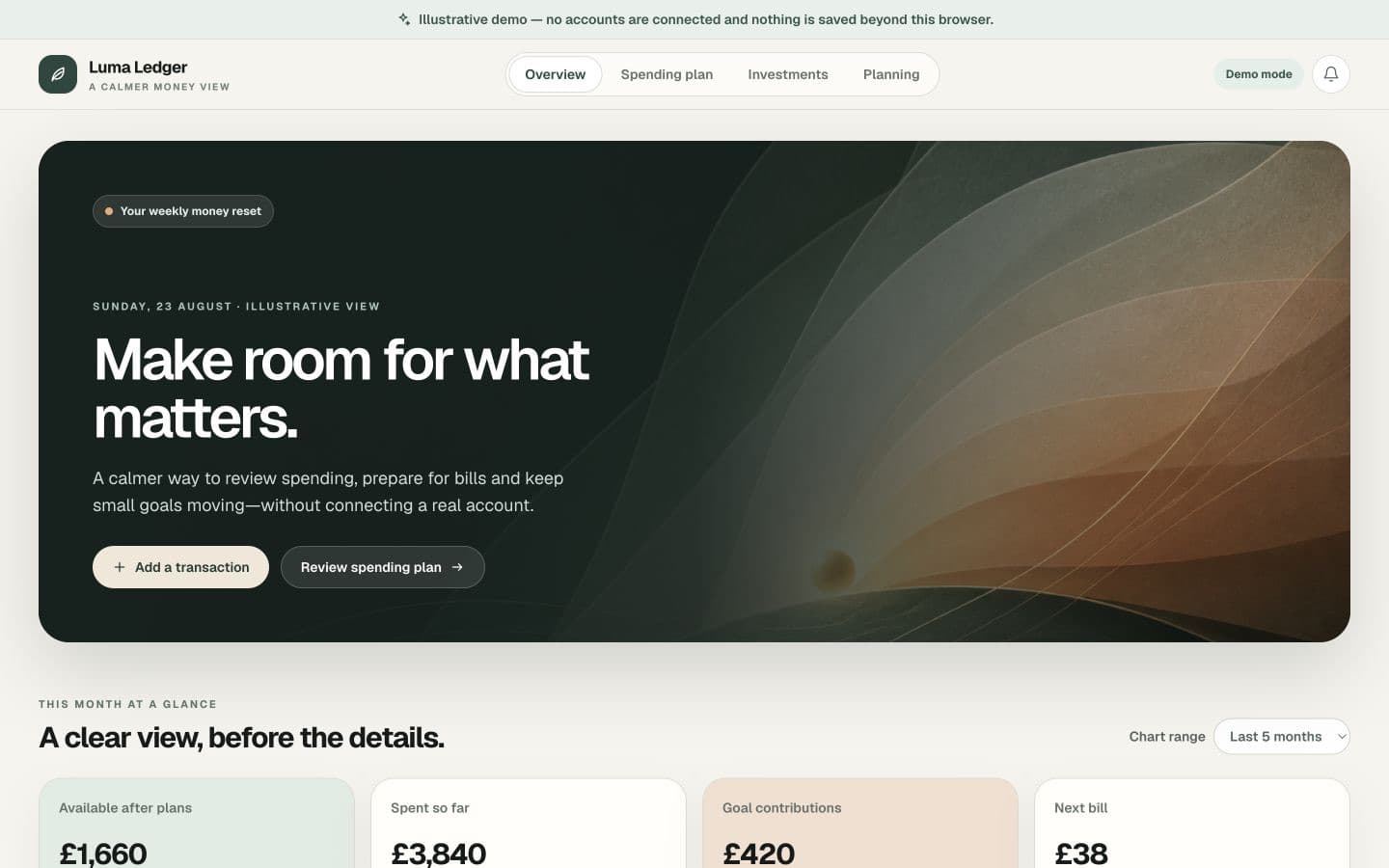
Luma Ledger demonstrates local transaction and goal flows alongside a responsive dashboard. Its project entry explains the sample data and browser-only limits, so you can assess the interaction without mistaking it for a production financial system.
You can also try the enquiry review demonstration to see a request move through preparation and human approval.
Project approach
01
Identify users, current tools, exceptions and the decisions the application needs to support.
02
Agree integrations, data sources, permissions and any operational or regulatory constraints requiring specialist advice.
03
Review the important user journeys with representative users before committing to the full implementation.
04
Define the initial release and acceptance criteria. Review new requests for cost and timing before changing the scope.
05
Implement the agreed workflows and check permissions, validation, error handling and representative usage.
06
Provide the agreed documentation, account access and operational guidance. Plan maintenance and future changes separately.
Planning for day-to-day use
Identify the data collected, who needs access and how permissions are enforced. Retention, backups and recovery requirements belong in the scope. Sensitive or regulated use may require specialist assessment; no certification or independent audit is implied.
Prefer clear interfaces, reusable code and documented integrations. Agree ownership, hosting, monitoring, maintenance responsibilities and support arrangements so there is a practical plan for keeping the application usable.
Useful details
We inspect the available API, account access, permissions, data format and provider terms during scoping. Compatibility is checked for the specific system; an integration is not assumed to exist.
The scope depends on workflows, user roles, data, integrations, migration, complexity and support requirements. We agree the initial release and acceptance criteria before quoting a build. Subscriptions and hosting are identified separately.
Yes. We identify the smallest useful workflow and agree what the initial release will and will not do. Later features are scoped as changes rather than implied additions.
From the blog
Read the practical details before deciding what your project needs.
Compare an existing product, an integration and a bespoke application before committing to a software build.
A useful first conversation
Tell us who uses it, where information is held and which steps are difficult today. You do not need a technical specification to start.
Tell us what you need and what you already have. We’ll review the enquiry and discuss the information needed to agree a scope.